
WWA Takes Off With EcoFlight

Our work is as diverse as Wyoming's public wild landscapes.
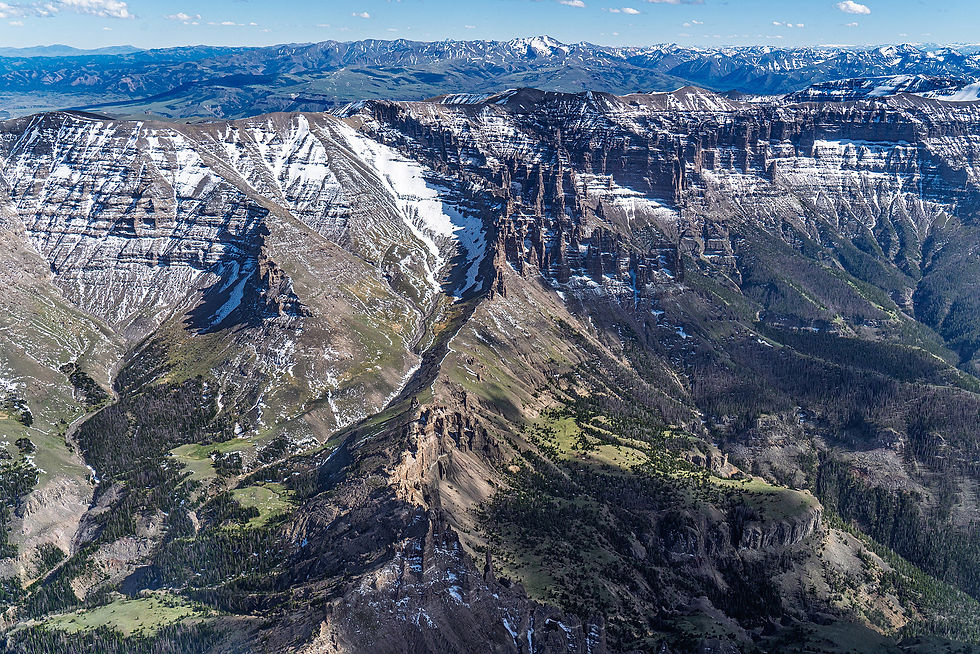
When Ecoflight contacted the WWA team this spring to ask whether we had any pressing advocacy issues on our plate that would benefit from a birds eye view, the answer was obviously yes. If you have been keeping up with our communications over the last year and a half, the reality is that we are swamped with issues that all matter, across the Bureau of Land Management (BLM) and the National Forest (NF) lands in the state. Through brainstorms, partnerships and a tireless quest for RSVPs, on June 11th we collaborated on two meaningful flights out of Cody, WY. The time in the air served our mission, while also giving the WWA team and the passengers we invited along an elevated perspective on the wildness of our Wyoming backyard.
Roadless Rule Flight
By Peggie dePasquale

The first flight of the day was focused on WWA’s ongoing work to oppose efforts to rescind and nullify the 2001 and Roadless Rule including HR. 7695 introduced by Wyoming Congresswoman Hageman, and S. 140 introduced by Wyoming Senator Barrasso.
On the morning of the flights, there was a palpable energy driven by nerves and anticipation as we briefed passengers and walked out to the plane. Included in the group was our EcoFlight pilot, Chris Bengston; Senate Candidate for Wyoming, Jimmy Skovgard; Former State Legislator, Sandy Newsome; Backcountry Horsemen member and volunteer, Howard Sanders; and Cody Enterprise Reporter, Buzzy Hassick.

It was hard to tell where the group fell on the issue, and so I approached my narration and advocacy as objectively as possible, with facts and figures, and anecdotes from experts who know way more than I do. However, after piling the six of us into the small plane, like sardines in a can, and taking off to fly over the five different Inventoried Roadless Areas of the day, nerves settled, conversation ensued, and something became clear: The people on the plane all cared deeply about the landscapes we were flying over, and recognized that while the acreage we were discussing was in one regard very small, the implications of these special places losing their protection was very large.
We discussed the information that was being used to justify getting rid of the rule, and the long list of evidence that was at odds with these claims. We discussed the role of forest fire in a healthy ecosystem, and also the role that people play in starting fire. We discussed the importance of these roadless landscapes like Carter Mountain and Franc’s Peak to beloved wildlife populations, and the important role that these roadless areas play in protecting clean water for millions of people who live downstream. We discussed the landscape's ruggedness and beauty, and how much the wild country meant to all of us.

Landing back down at the airport after some minor turbulence, followed by one of the smoothest landings I’ve ever experienced, the team hopped out of the plane, with a new energy in the air, possibly the relief of being back on the ground safely, but it was more that feeling of comradery that comes from sharing in a meaningful experience.
Following the flight, discussions carried over, and one by one passengers went on their way. But the impact was not over. The following week, the Cody Enterprise published a story about the flight and the Roadless Rule that ended up being picked up around the state, including in the Jackson Hole Daily, the Laramie Boomerang, and the Wyoming Star Tribune. Following the flights, we were approached about doing a full feature on the Roadless issue with the radio station 89.1 KHOL. And just last week, Howard Sanders from the Backcountry Horseman, shared with us a meaningful conversation he had with Congresswoman Hageman on the Roadless Rule, and although he didn’t feel he changed her mind, he was grateful to have had the experience and the discussions from our EcoFlight to inform himself and his advocacy.
Just like Inventoried Roadless Areas that protect the headwaters of our country, WWA’s advocacy work like these recent EcoFlights, originating in the wildlands of Wyoming, has a tremendous impact and importance downstream.
BLM WSA Flight
By Jennie Mans

When I bought my first car that was trustworthy enough to drive across state lines without breaking down, I started to visit public lands around the country. Some of my very first ventures into independently traveling were the Bureau of Land Management (BLM) landscapes I now return to in the same car. These experiences were incredibly transformative: through my connection of self, place, and first hand experience, I came to identify with these wild lands and the solitude and self-reliance that they afforded me. It is safe to say that the public land advocacy I professionally engage in now was born out of these unassuming yet life-changing moments.
I am grateful to have built this relationship to public lands at the time in my life that I did, but I also understand how powerful these experiences can be even earlier on in life. In conversation with Wyomingites across the state, many people’s reason for why Wilderness matters to them is that they had a significant experience on the land, particularly at a young age. As I navigate my work, I am therefore particularly interested in youth wilderness programs that can be the catalyst to set a whole life’s trajectory in motion.
For this collaboration with EcoFlight, I had the incredible opportunity to take a handful of Cody High School and Youth for Justice students on our second WWA itinerary of the day. We flew over seven BLM Wilderness Study Areas (WSAs) in Park, Bighorn, and Washakie counties, covering 102,000 of the roughly 500,00 WSA acres in the state. Many of these WSAs, despite their arid and rugged nature, are some of the most intact ecosystems left in the United States, and support a surprising amount of biological diversity. And while these lands remain undeveloped, they also remain relatively unprotected: the state of Wyoming has no Wilderness on BLM lands, even as these WSAs are being managed for their “outstanding opportunities for Wilderness characteristics.” This leaves their fate in a precarious state.

My conversation with the students started broad - as we covered the ground below, so, too, did we cover what exactly we mean when we talk about federal public land, and particularly Wilderness, management in the multi-use of our public lands. We acknowledged how lucky we are to have access to so much wilderness quality landscapes in our “backyard,” and marveled at the ecological diversity below us - badlands, dune fields, rock outcrops, hoodoos, and sagebrush sea contrasted with canyons and clear, cascading streams.

As we took in the variety of landscapes, I asked the students to reflect on their personal relationship to public lands and to Wilderness, and got to hear firsthand how engaged in public land advocacy and education they already are. While we discussed the history of WSAs and the students’ collective power in stewarding them, they educated me on opportunities they’ve pursued to engage with legislation on these very issues. From lobbying to speaking with candidates at their “Politics in the Park” event, these students are passionately engaging with issues at all levels of government. From ice climbing to pictograph hikes, these students are well versed on the inherent cultural, recreational, and scenic values of their public lands, and are no strangers to the value of their vote and voice when it comes to the future of these landscapes. I was so impressed by their grit and acumen - the future of Wyoming Wilderness is in very good hands.
Once unloaded from the plane, and after thanking our pilot, I asked the students if they had a favorite WSA and what their biggest takeaways were from the day. As vast as high-schoolers' interests were, so too were the wild landscapes that spoke to them: the colorful badlands of McCullough Peaks captivated some, while the thousand foot canyon walls of Medicine Lodge left their mark on others. But they all agreed on one thing - that they care deeply about these places and see a need for their voice in the future decision-making process of Wilderness.


Comments